SEPTEMBER 2025
thinking differently about a controversial proposal
There can be times when the "crash through or crash" approach is a winner. Usually, however, circumstances are far more complex and benefit from nuance and gentle movements. That thought was prompted yesterday when reading the criticism of the Tasmanian Planning Commission of the proposed Macquarie Point stadium in Hobart.
The early images of this stadium eighteen months ago gave the impression of focus on the internal dynamic of the stadium at the expense of fitting the complex deftly into its surrounds.
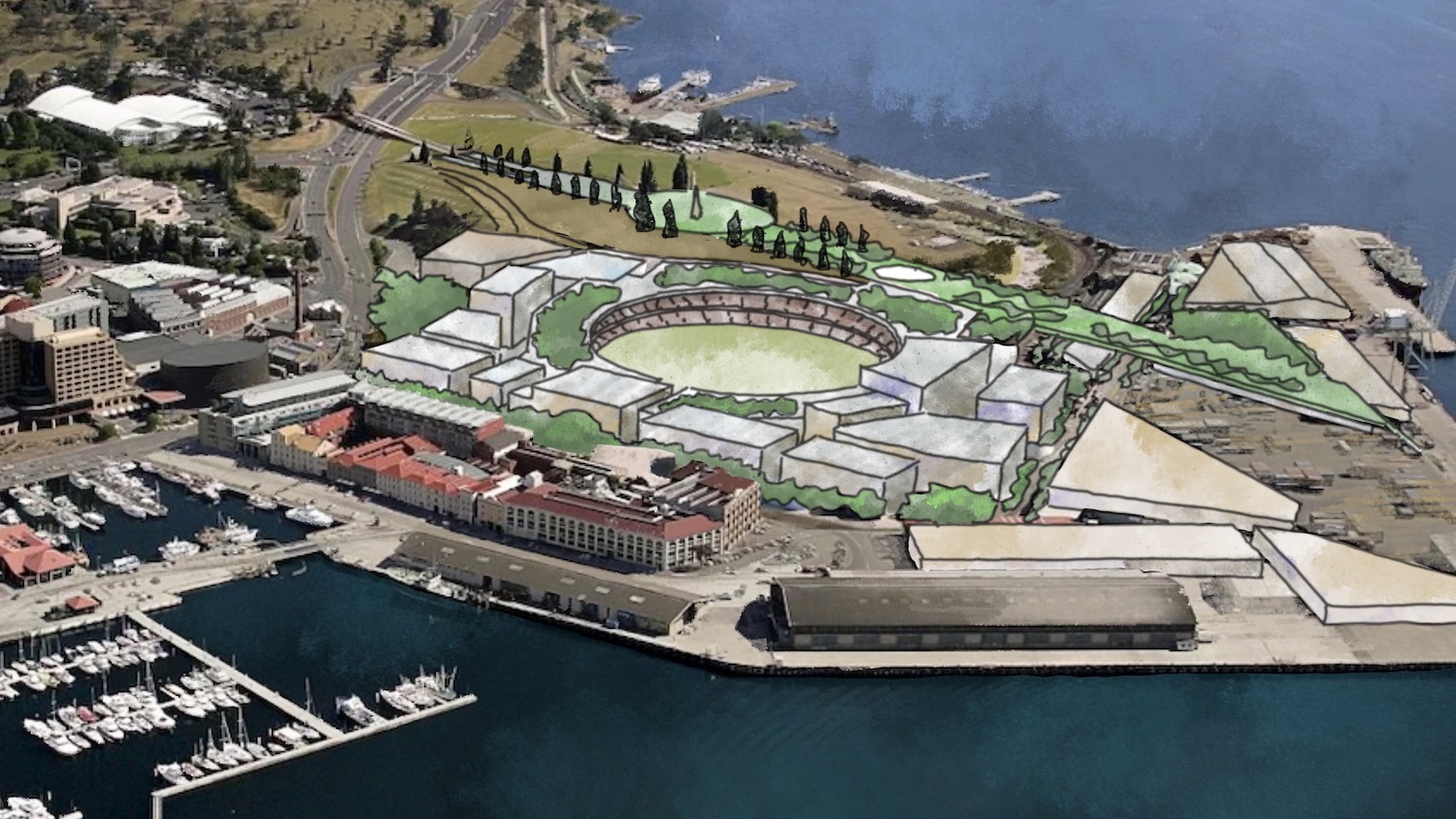
At that time, Steven Smit and I started talking about different possibilities at Macquarie Point. Inspired by those conversations I dived into exploring an approach which took as its starting point the the history of the place, the existing Hobart fabric, the physical and historical presence of the Cenotaph and the importance of First Nations presence. All the while leveraging into this space a sporting stadium which could physically sublimate itself to those influences while wholeheartedly acting out its important role.
Why do that? Really, just to see if it could be done. And also to persuade myself that life (and our cities) need not be so binary as is sometimes made out.
But, you may ask, why have a sporting stadium at Macquarie Point at all? The full answer to that would be much longer than I have space for here. However a quick response might be…if we could do it so that there are real benefits and few impacts, why not explore that possibility?
For nearly a decade I was a member of what was then the primary design review panel in Canberra. At one time we mused on the opportunity, flagged by the ACT government, of a city sporting stadium. Being from Melbourne I was keenly aware of the contribution of our central sporting venues to the civic life of the city, even for someone with no particular attachment to organised sport. The Canberra possibility, which subsequently appeared in the insightful Linking Canberra to the Lake study created by Philip Thallis and his team, prompted me at that time to study urban stadia. As a result considering siting one in Hobart didn't seem far fetched, even if it wouldn't be easy.
The drawings I did at the time are clearly not a design, simply visual explorations. However they do prompt some questions that were perhaps not asked by the information viewed by the planning Commission, the responses to which could offer insights leading to a design.
Could we take advantage of the ground levels to set the stadium below the cenotaph, thereby maintaining the cenotaph's hegemony of height? If the playing ground is accordingly self-effacing and "buried" horizontally and vertically within bounding community-use buildings that face outwards and engage properly with the surrounds, could that result in us gaining the benefits from the stadium while simultaneously adding to the surrounding urban life? Could "buried" could also mean "open", given Campbell Rose and the Western Bulldogs showed us a couple of decades ago how a sporting ground could be transformed from rampart to community hub?
Could we create a landscaped extension of Anzac Parade to the waterfront and could that extension be an axially significant place for recognition and celebration of First Nations peoples? Would the Big Gesture of that axial cenotaph passage override the sheer horizontal scale of the stadium?
These questions are just some of the many that could be asked. Given the current outcome, has that chance been lost?